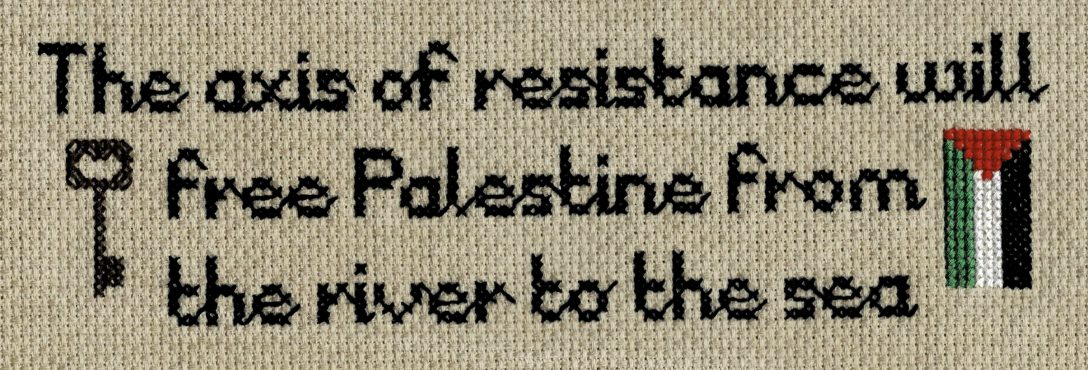
Resistance Embroidery Fundraiser for Palestine

Inna Lillahi wa inna ilayhi raji’un. Our worst nightmare became a reality yesterday [June 15, 2025]. Our dear, beloved Mosab was martyred. He was taken from us by the sick, evil occupier. Mosab WAS The Sameer Project. But we will not stop. We can’t. We won’t and we will continue to serve Gaza, for Mosab, for all those who are suffering.

This page is designed as an effort to raise funds for @sameerproject, “a donations based aid initiative, led by Palestinians, working to supply emergency shelter and aid to displaced families in Gaza.”

Please visit The Sameer Project to see more about their initiatives. I have no direct connection to the organization, other than I have donated to them, and they are highly regarded in the Palestine Liberation community. 90% of the proceeds will go to The Sameer Project. All of these original pieces are hand embroidered on cross stitch fabric. Important info: If you’d like a selection of different pieces from the list below, please email me at pritigulaticox(@)gmail.com with the name and quantity of each piece you’d like, and I can save you money on the shipping.

So far, we have raised close to $8500.00 for The Sameer Project, both through orders of these listed pieces below, and through personal, custom embroidered works. If you have an idea for a custom embroidery project separate from this list, then email me and we can take it from there. Thank you for your support!

‘The masks are off’ bookmark

2″ x 7″ Important shipping info: The price of this embroidery piece includes $7.00 for shipping (that includes a tracking #) within the US. If you’re ordering from anywhere outside the US, please email me at: pritigulaticox(@)gmail.com, and I’ll let you know how much the additional shipping cost will be. Thanks!

$32.00

‘these threads resist fascists’ bookmark

This is indeed a therapy bookmark, and you can point it wherever you want to complete its meaning. 6.5″ x 1.75″ Important shipping info: The price of this embroidery piece includes $7.00 for shipping (that includes a tracking #) within the US. If you’re ordering from anywhere outside the US, please email me at: pritigulaticox(@)gmail.com, and I’ll let you know how much the additional shipping cost will be. Thanks!

$37.00

“Nearly 270 journalists [including Anas Al-Sharif & Hossam Shabat] and media workers have been killed by Israeli attacks in Gaza in 22 months of war – or about 13 journalists every month – according to a tally by Shireen.ps, a monitoring website named after Al Jazeera journalist Shireen Abu Akleh, who was shot and killed by Israeli forces in the occupied West Bank in 2022.” Al Jazeera, Here are the names of the journalists killed in Gaza, August 11, 2025

‘Anas Al-Sharif’ bookmark

2″ x 6.25″ Important shipping info: The price of this embroidery piece includes $7.00 for shipping (that includes a tracking #) within the US. If you’re ordering from anywhere outside the US, please email me at: pritigulaticox(@)gmail.com, and I’ll let you know how much the additional shipping cost will be. Thanks!

$37.00

‘Hossam Shabat’ bookmark

2″ x 6.5″ Important shipping info: The price of this embroidery piece includes $7.00 for shipping (that includes a tracking #) within the US. If you’re ordering from anywhere outside the US, please email me at: pritigulaticox(@)gmail.com, and I’ll let you know how much the additional shipping cost will be. Thanks!

$37.00

As many of us know, Refaat Alareer was a beloved Palestinian poet, professor, educator and mentor who was murdered by the Israelis in an airstrike on December 6, 2023. He is famous for his poem ‘If I Must Die,’ which was translated in many languages after he was killed. But he is also famous for saying what he would do if he was ever attacked by Israel:

‘Refaat Alareer portrait’ bookmark

2.25″ x 8″ Important shipping info: The price of this embroidery piece includes $7.00 for shipping (that includes a tracking #) within the US. If you’re ordering from anywhere outside the US, please email me at: pritigulaticox(@)gmail.com, and I’ll let you know how much the additional shipping cost will be. Thanks!

$42.00

‘Refaat Alareer quote’ bookmark

2″ x 8″ Important shipping info: The price of this embroidery piece includes $7.00 for shipping (that includes a tracking #) within the US. If you’re ordering from anywhere outside the US, please email me at: pritigulaticox(@)gmail.com, and I’ll let you know how much the additional shipping cost will be. Thanks!

$32.00

‘If I must die’ kite-shape bookmark

3.25″ x 3.25″ + string Important shipping info: The price of this embroidery piece includes $7.00 for shipping (that includes a tracking #) within the US. If you’re ordering from anywhere outside the US, please email me at: pritigulaticox(@)gmail.com, and I’ll let you know how much the additional shipping cost will be. Thanks!

$97.00

‘If I must die poem by Refaat Alareer’ wall piece

8″ x 6.5″ Important shipping info: The price of this embroidery piece includes $7.00 for shipping (that includes a tracking #) within the US. If you’re ordering from anywhere outside the US, please email me at: pritigulaticox(@)gmail.com, and I’ll let you know how much the additional shipping cost will be. Thanks!

$97.00

22-year-old Palestinian journalist and commentator Abubaker Abed, who, despite the Zionist genocide that has engulfed him and his people (a holocaust supported by Western governments, especially the United States), has been taking care of a yellow rose bush, among other plants.  On an Apr 27, 2024 interview with The Electronic Intifada Abubaker said: “This is our yellow rose. It is in fact the best thing we have at the moment. Because, we see hope through it. Despite the destruction, despite the truly unbearable circumstance we are living under at the moment, we still seek out hope [and] we see hope in you… I, Abubaker, am sending a message of love, a message of hope to everyone of you from Central Gaza, in Deir al-Balah.”

‘Abubaker yellow rose’ bookmark

6″ x 2″ Important shipping info: The price of this embroidery piece includes $7.00 for shipping (that includes a tracking #) within the US. If you’re ordering from anywhere outside the US, please email me at: pritigulaticox(@)gmail.com, and I’ll let you know how much the additional shipping cost will be. Thanks!

$37.00

Hope earrings

Important shipping info: The price of this embroidery piece includes $7.00 for shipping (that includes a tracking #) within the US. If you’re ordering from anywhere outside the US, please email me at: pritigulaticox(@)gmail.com, and I’ll let you know how much the additional shipping cost will be. Thanks!

$27.00

Dr. Hussam Abu Safiya was abducted by Israeli soldiers after a raid on the Kamal Adwan Hospital in northern Gaza on December 27, 2024. According to Euro-Med Human Rights Monitor, Jan 3, 2025, “The detention of Dr. Abu Safiya must be understood within the context of Israel’s ongoing genocide in Gaza, which has persisted for nearly 15 months. His arrest, torture, and potential execution form part of a broader strategy aimed at destroying the Palestinian people in Gaza—both physically and psychologically—and breaking their will.”

‘Free Dr. Hussam Abu Safiya’ bookmark

2″ x 6.5″ Important shipping info: The price of this embroidery piece includes $7.00 for shipping (that includes a tracking #) within the US. If you’re ordering from anywhere outside the US, please email me at: pritigulaticox(@)gmail.com, and I’ll let you know how much the additional shipping cost will be. Thanks!

$42.00

Ghassan Kanafani, born in 1936 in Acre (northern Palestine) was a renowned Palestinian writer, artist, journalist, and major spokesman for the Popular Front for the Liberation of Palestine. Also the founding editor of PFLP’s weekly magazine Al-Hadaf, Kanafani was assassinated in 1972 along with his niece in a car-bomb explosion orchestrated by Israel’s national intelligence agency, the Mossad, in Beirut. According to Louis Allday for Mondoweiss, Sep 11, 2023, “Kanafani was many things at the time of his death, including a celebrated author, a Marxist-Leninist, a Pan-Arabist, a comrade, a refugee, an artist, a husband, an uncle, and a father.”

‘Ghasan Kanafani quote’ bookmark

2″ x 8″ Important shipping info: The price of this embroidery piece includes $7.00 for shipping (that includes a tracking #) within the US. If you’re ordering from anywhere outside the US, please email me at: pritigulaticox(@)gmail.com, and I’ll let you know how much the additional shipping cost will be. Thanks!

$32.00

IMG_1674

Dr. Abu Safiya patch & a bookmark

Important shipping info: The price of this embroidery piece includes $7.00 for shipping (that includes a tracking #) within the US. If you’re ordering from anywhere outside the US, please email me at: pritigulaticox(@)gmail.com, and I’ll let you know how much the additional shipping cost will be. Thanks!

$27.00

‘Ghasan Kanafani portrait’ bookmark

8″ x 2″ Important shipping info: The price of this embroidery piece includes $7.00 for shipping (that includes a tracking #) within the US. If you’re ordering from anywhere outside the US, please email me at: pritigulaticox(@)gmail.com, and I’ll let you know how much the additional shipping cost will be. Thanks!

$42.00

resisance earrings

Important shipping info: The price of this embroidery piece includes $7.00 for shipping (that includes a tracking #) within the US. If you’re ordering from anywhere outside the US, please email me at: pritigulaticox(@)gmail.com, and I’ll let you know how much the additional shipping cost will be. Thanks!

$37.00

Resistance fighter Leila Khaled was born in Haifa, Palestine in 1944. She grew up a refugee in Lebanon, and was a member of The Population Front for the Liberation of Palestine (PFLP). Leiis well known for being the first woman to hijack a plane in 1969. She now lives in Jordon, and continues to work for liberation. This quote is taken from an interview she did with Mondowiess in Dec 2024

‘Leila Khaled’ bookmark

2″ x 8″ Important shipping info: The price of this embroidery piece includes $7.00 for shipping (that includes a tracking #) within the US. If you’re ordering from anywhere outside the US, please email me at: pritigulaticox(@)gmail.com, and I’ll let you know how much the additional shipping cost will be. Thanks!

$37.00

‘Twenty-one months of steadfastness’ bookmark

2.5″ x 7.75″ Important shipping info: The price of this embroidery piece includes $7.00 for shipping (that includes a tracking #) within the US. If you’re ordering from anywhere outside the US, please email me at: pritigulaticox(@)gmail.com, and I’ll let you know how much the additional shipping cost will be. Thanks!

$57.00

‘A people’s struggle against its occupiers’ bookmark

2.5″ x 8″ Important shipping info: The price of this embroidery piece includes $7.00 for shipping (that includes a tracking #) within the US. If you’re ordering from anywhere outside the US, please email me at: pritigulaticox(@)gmail.com, and I’ll let you know how much the additional shipping cost will be. Thanks!

$32.00

Hamas leader and martyr Yahya Sinwar was killed while battling the occupiers on October 16, 2024. His last act of resistance was throwing a stick at an Israeli drone that was filming him. An image that is singed into the memory of every non-surrendering child in Gaza. Sinwar wasn’t targeted for assassination by Israel like Haniyeh and Nasrallah were. He died in battle, among his men. This quote is taken from a 2018 interview with La Repubblica reporter Francesca Borri:

‘Yahya Sinwar quote’ bookmark

2″ x 8″ Important shipping info: The price of this embroidery piece includes $7.00 for shipping (that includes a tracking #) within the US. If you’re ordering from anywhere outside the US, please email me at: pritigulaticox(@)gmail.com, and I’ll let you know how much the additional shipping cost will be. Thanks!

$32.00

Hamas leader and martyr Yahya Sinwar was killed while battling the occupiers on October 16, 2024. His last act of resistance was throwing a stick at an Israeli drone that was filming him. Jon Elmer is a contributing editor at The Electronic Intifada, and brings us weekly resistance reports from Gaza and the West Bank.

‘From Shawqi to Sinwar to Elmer through my needle to you’ bookmark

2″ x 8″ Important shipping info: The price of this embroidery piece includes $7.00 for shipping (that includes a tracking #) within the US. If you’re ordering from anywhere outside the US, please email me at: pritigulaticox(@)gmail.com, and I’ll let you know how much the additional shipping cost will be. Thanks!

$42.00

Abu Obeida quote 2

Important shipping info: The price of this embroidery piece includes $7.00 for shipping (that includes a tracking #) within the US. If you’re ordering from anywhere outside the US, please email me at: pritigulaticox(@)gmail.com, and I’ll let you know how much the additional shipping cost will be. Thanks!

$32.00

Abu Obeida quote

Important shipping info: The price of this embroidery piece includes $7.00 for shipping (that includes a tracking #) within the US. If you’re ordering from anywhere outside the US, please email me at: pritigulaticox(@)gmail.com, and I’ll let you know how much the additional shipping cost will be. Thanks!

$32.00

Jon Elmer (@jonelmer) is a contributing editor at The Electronic Intifada, and brings us weekly resistance reports from Gaza and the West Bank.

‘Jon Elmer quote’ bookmark

2″ x 7″ Important shipping info: The price of this embroidery piece includes $7.00 for shipping (that includes a tracking #) within the US. If you’re ordering from anywhere outside the US, please email me at: pritigulaticox(@)gmail.com, and I’ll let you know how much the additional shipping cost will be. Thanks!

$32.00


‘From under the rubble’ bookmark

2″ x 8″ Important shipping info: The price of this embroidery piece includes $7.00 for shipping (that includes a tracking #) within the US. If you’re ordering from anywhere outside the US, please email me at: pritigulaticox(@)gmail.com, and I’ll let you know how much the additional shipping cost will be. Thanks!

$32.00

‘Fighters & Olives’ bookmark

Important shipping info: The price of this embroidery piece includes $7.00 for shipping (that includes a tracking #) within the US. If you’re ordering from anywhere outside the US, please email me at: pritigulaticox(@)gmail.com, and I’ll let you know how much the additional shipping cost will be. Thanks!

$42.00

‘What else needs to be said?’ bookmarks

Important shipping info: The price of this embroidery piece includes $7.00 for shipping (that includes a tracking #) within the US. If you’re ordering from anywhere outside the US, please email me at: pritigulaticox(@)gmail.com, and I’ll let you know how much the additional shipping cost will be. Thanks!

$40.00

‘This Lebanon’ bookmark; $ 42.00. The price of this embroidery includes $7.00 for shipping within the US. If you’re interested in ordering this piece, please email me at pritigulaticox(@)gmail.com for more info.
‘Abu Obeida quote 3’ bookmark; $ 32.00. The price of this embroidery includes $7.00 for shipping within the US. If you’re interested in ordering this piece, please email me at pritigulaticox(@)gmail.com for more info.
‘Armed resistance is our right’ bookmark; $ 42.00. The price of this embroidery includes $7.00 for shipping within the US. If you’re interested in ordering this piece, please email me at pritigulaticox(@)gmail.com for more info.
‘Tandem-85‘ wallpiece. If you’re interested in ordering this piece,
please email me at pritigulaticox(@)gmail.com for more info.
‘Al-Aqsa Mosque‘ wallpiece. I am modifying this piece a little from the original. If you’re interested in ordering this piece, please email me at pritigulaticox(@)gmail.com for more info.
‘Abu Obeida‘ wallpiece. I am modifying this piece a little from the original. If you’re interested in ordering this piece, please email me at pritigulaticox(@)gmail.com for mote info.
‘Refaat Alareer portrait‘ wallpiece. I am modifying this piece a little from the original. If you’re interested in ordering this piece, please email me at pritigulaticox(@)gmail.com for more info.
‘Free Palestine‘ wallpiece. I am modifying this piece a little from the original. If you’re interested in ordering this piece, please email me at pritigulaticox(@)gmail.com for more info.
‘Kwame Ture quote‘ bookmark, $ 32.00 If you’re interested in ordering this piece, please email me at pritigulaticox(@)gmail.com for more info.

The Resistance Fights On, as the Cowardly Crusaders Flounder

By Stan Cox

‘Armed resistance is our right’ bookmark. Please go here to purchase this bookmark in support of The Sameer Project, a mutual aid initiative led by Palestinians in Gaza.

With a fictional ceasefire in place, Israel continues its genocide in Gaza, just in a lower gear. The people of Gaza are still living each day amid the chaos and terror brought by Israel. And Israeli leaders are still making crystal clear their intentions to destroy Palestinian society and erase from collective memory the fact that Palestinians ever existed. 

Meanwhile, the armed resistance groups in Gaza, the West Bank, and Lebanon carry on toward their common goal: to drive Israeli occupation forces out of their respective homelands and end the slaughter, displacement, and dispossession of their people. They’d rather be living a normal life. They wouldn’t be firing a single rocket, shell, or bullet if Israelis were not constantly committing atrocities in an effort to seize all of Palestine, southern Lebanon, and lands beyond. 

Palestinian and Lebanese armed resistance to Israeli occupation is justified under a large body of international law. Israel’s declarations of genocidal intent and its genocidal actions of the past 31 months have strengthened the case for armed resistance even more. And the abject refusal of the US, EU, and UN to sanction and disarm Israel has sharpened the existential necessity that Palestinians engage in armed self-defense.

It’s All the One Long Struggle

In March, with the US and Israel having launched their unprovoked war on Iran, Wissam Charafeddine of Dearborn Blog wrote against the kind of “realism” that pundits always use to justify the initiation of such illegal military conflict—lame arguments that, he wrote, go something like this: “Yes, there is aggression, but what about Iran? Yes, there is an illegal war, but what about the regime?” Of course, he noted, this illogic is routinely applied to Israel’s long history of aggression against the Palestinians:

The obsession with false balance has done enormous damage in our part of the world. Every time an existential threat becomes visible, some commentators rush to flatten the hierarchy of dangers. The occupier and the occupied. The invader and the invaded. The empire and the state under bombardment. Everyone gets blended into one gray puddle. Then we are told this is maturity.

Ramzy Baroud, editor of The Palestine Chronicle, made a similar point regarding Palestine in an April essay, arguing that too many Americans who claim to be anti-war or even pro-Palestinian

. . . acknowledge Israeli crimes but feel compelled to condemn Palestinian “terrorism.” They oppose Israeli policies yet insist on distancing themselves from Hamas and the others, as if Palestinian resistance exists outside the historical and political reality that produced it. They speak of “extremists on both sides,” as though figures like Itamar Ben-Gvir and a Palestinian fighter in Gaza can be meaningfully compared.

A year and a half into the Gaza genocide, Mohammad Mishal, a scholar of international human rights law, wrote that, because Israel has forcibly occupied the West Bank and Gaza continuously since 1967, the Palestinians’ right to self-defense and self-determination in their homeland has remained in effect throughout the past six decades. (Israeli troops were not inside Gaza from 2007 to 2023, but they controlled it as an open-air prison throughout those years, and did a lot of bombing.) Therefore, wrote Mishal, any “military operation aimed at ending their occupation would not be the beginning of a new conflict.” For example, the Palestinian resistance’s October 7, 2023 operation was not the initiation of a war but the continuation of a people’s longstanding struggle against illegal occupation.

In Zionist propaganda, that continuous, decades-long struggle has instead been depicted as a series of singular eruptions that pop up every few years, each supposedly initiated by the Palestinians just because that’s how they are. But in the world we actually inhabit, the baseline of this conflict has been one long campaign of aggression and occupation initiated and carried out by Israel, always with US support. The resistance’s actions, meanwhile, have always been aimed at ending Israel’s control over Palestinian land and lives.

An Army Versus a People

In his post, Charafeddine urged that we “refuse to let every conversation begin by interrogating the target of attack before we name the attacker.” In that spirit, let’s not entertain any debate over Occupied Palestine that begins with the accusatory question, “Do you condemn Hamas?!” We begin instead by identifying the State of Israel as the aggressor and Palestine as the target.

Over many years, the chief functions of the Israeli military were to enforce apartheid in the West Bank and lay siege to the Gaza Strip—in other words, to impose confinement and deprivation on the entire population of the Occupied Territories. Palestinians’ attempts to achieve liberation from the horror through nonviolent action have been met with increasingly horrific violence.

That came to a head in 2018–19 when unarmed civilians in Gaza mounted a long series of weekly nonviolent protests known as the Great March of Return. Occupation forces outside the border fence responded with sniper fire. In total, Israeli troops killed 226 marchers, including dozens of children, and intentionally injured more than 30,000. Finally in 2023, with conditions in the territory becoming unbearable, the resistance planned and executed the October 7 prison break and military operation that overwhelmed the Israeli army bases surrounding Gaza.

The armed conflict has always followed a predictable pattern: Israeli troops wage war on civilians and their means of subsistence, while resistance forces fight a defensive war against Israeli military targets. (To any reader now shouting, “What about what Hamas did on October 7!!?”, I recommend The Electronic Intifada’s extensive body of work debunking Israeli/US propaganda about that day.)

For more than two years, the Israeli military’s war on Gaza has only incidentally involved engaging the Palestinian resistance fighters in battle. Occupation troops have stayed safely out of harm’s way, seated in US-supplied aircraft over Gaza, dropping bombs and firing missiles on civilian areas. Others are miles away on the ground, firing artillery shells or sitting at desks as they steer deadly armed drones over and through Gaza’s cities, camps, and fields, shooting children, women, and men.

Israeli leaders’ goal in Gaza, and increasingly in the West Bank, is not to defeat the resistance militarily but to render life so unbearable for the civilian population that they will allow themselves to be forced out. The monsters in Tel Aviv have openly and endlessly declared this genocidal intention. Month after month, we’ve seen the horrific results: near-total destruction of the territory’s housing, health care, public-safety agencies, transportation, water, energy, and food systems; a total of more than 72,000 human beings killed, a majority of them children or women. 

Starting decades before the full-blown genocide and on an even greater scale since, Israel has also abducted and imprisoned tens of thousands of Palestinians. Their prisons, though, are better characterized as torture camps. A recent report from Euro-Med Human Rights Monitor, on sexual torture in these places, goes way, way beyond gut-wrenching. On the few occasions when the resistance has launched offensive military operations—most recently and prominently in the October 7 jailbreak—the goal has been to capture occupation troops that they can swap for Palestinians held captive by Israel. 

The Palestinian resistance attacks soldiers, not civilians. And they fight in person, not from cushioned seats. On those occasions when ground troops have ventured into Gaza’s cities or camps seeking to seize and hold ground, they’ve found Palestinian fighters waiting for them, ready to kill or drive them out, firing weaponry that they design and manufacture themselves. The occupation troops don’t like to venture out of their tanks and armored personnel carriers (APCs), because resistance sharpshooters in upper floors of bombed-out buildings are ready to pick them off if they do.  In so-called “return to sender” missions, the resistance has destroyed or disabled countless Israeli tanks, APCs, bulldozers, and other equipment with bombs they manufactured using undetonated explosives recovered from Israel’s US-supplied bombs and other munitions. 

The resistance targets only those soldiers who pose a threat. They never attack medevac helicopters that come to carry away Israel’s wounded and dead. And they abide by ceasefires, including the one now supposedly in effect—one that Israel has violated more than 2,000 times, killing 750 Palestinians in the process.

To Team Israel/USA: Three Strikes and You’re Out!

Israel is the aggressor in Lebanon as well, and is fully supported, as always, by the US. For many years, it has made a habit of bombing and invading its neighbor to the north. Current attempts to seize and occupy southern Lebanon—in violation of a ceasefire, of course—are looking very much like the genocide in Gaza. Its troops are forcibly displacing entire communities and bombing homes, businesses, and other civilian targets. From March 2 through May 2, they killed more than 2,500 civilians, wounded more than 8,000, and forced more than one million people into homelessness. 

‘This Lebanon’ bookmark. Please go here to purchase this bookmark in support of The Sameer Project, a mutual aid initiative led by Palestinians in Gaza.

These attacks have ruined life in southern Lebanon. But as attempts to occupy and control the region, they have failed miserably. Thanks to formidable resistance mounted by local Hezbollah fighters, Israeli troops have captured and held very little ground. Building and deploying ultra-cheap, innovative drones guided by fiber-optic wires, Hezbollah has been wreaking havoc on Israeli positions, equipment, vehicles, and troops. The invaders, powerless to advance more than a few miles into Lebanon, have focused on demolishing buildings and infrastructure wherever they find themselves bogged down.

Also, in their war on Iran, Israel and the US very plainly are the aggressors—and treacherous ones at that. Off and on throughout February, the US and Iran engaged in talks, mediated by Oman, the aim of which was to avoid conflict. Toward the end of the month, the Iranians agreed to all remaining terms, including a very significant dilution of their radioactive material. But just as the negotiations reached that especially productive stage, the US and Israel launched their massive surprise attack. In that initial blitzkrieg and through the weeks that followed, they hit civilian targets, including grade schools, universities, residential buildings, hospitals, water desalinization and power plants, and bridges. The civilian death toll exceeded 2,000, including more than 500 women, more than 400 children, and more than 90 health care workers. Iran responded by attacking energy facilities and US military bases located in six Persian Gulf countries.

‘Abu Obeida quote 3’ bookmark. Please go here to purchase this bookmark in support of The Sameer Project, a mutual aid initiative led by Palestinians in Gaza.

In Palestine . . . in Lebanon . . . in Iran, Team Israel/USA is the aggressor, and it’s floundering in all three conflicts. With treachery in negotiations and extravagant use of bombardment having failed to help them achieve their goals, Tel Aviv and Washington have resorted to just stamping their feet and demanding that Iran, Lebanon, and the Palestinians all surrender unconditionally. None of the three will surrender, of course. At one point in this terrible saga, Abu Obeida, spokesperson for the Al-Qassam Brigades, offered this pithy response to such demands: “What the enemy failed to take from us through tanks and war, it will not be able to take through politics or at the negotiating table.”

Team Israel/USA, now a military failure three times over, is still capable of doing grievous damage in West Asia and beyond for a while longer. But the era of US global dominance is fading fast, thanks in good part to the valiant, steadfast people of Gaza, the West Bank, Lebanon, and Iran.  

October 7: A History in Threads

Thread 11

Connecting the present to the past 141 years of Zionism and Israel’s occupation of Palestine

Click on any image, including embroidered quotes, to read more about it

According to professor Joseph Massad, “European Christian colonization of [Palestine] throughout much of the 19th century was the prelude to Zionist Jewish colonization at the end of it… By the 1850s, Palestine’s population was under 400,000 people, including about 8,000 Jews.”

As mentioned in thread 10, it was in the year 1882 that the Zionist settler colonization of Palestine began. Thirty-five years later, on November 2, 1917, UK’s foreign secretary, Arthur James Balfour completely changed the face of historic Palestine with the stroke of a pen by issuing the infamous “Balfour Declaration,” which favored the establishment in Palestine “of a national home for the Jewish people.”

A Palestinian home owner flies black flags to protest the visit of Arthur Balfour to Jerusalem in 1925

Israeli Historian Ilan Pappé tells us that soon after the 1967 war, defense minister Moshe Dayan opened the West Bank to Israelis for settler tourism: “Our guides were from the ‘Israel Exploration Society,’ founded in 1913 in an attempt to substantiate the Zionist claim for Palestine with archaeological finds.”

Only a settler Zionist, head full of phantom ideas, could lay claim to a “land without people” while surrounded by the people of that land.

And only a settler Zionist backed by US arms could do this to one of their own, and then blame Hamas for it…

… or this to a beloved Palestinian educator…

… or this to the niece of 22-year-old Palestinian journalist and commentator Abubaker Abed…

… or this to the library of a Palestinian writer & poet…

… or this to a Palestinian toddler…

… or this to the great martyr and resistance fighter Yahya Sinwar…

… or this to a Palestinian prisoner…

… who was gang raped by a group of reservists in the infamous Sde Teiman detention camp in the Negev desert, east of the Gaza Strip, prompting the “right to rape” riots where Israeli protesters, politicians and TV commentators were defending the right of soldiers to rape Palestinian prisoners in detention.

On November 13, Euro-Med Human Rights Monitor released an infographic that included a host of shocking statistics. Since the start of the war on Gaza, the Israeli military has engaged in a scorched earth policy, completely destroying “the strip’s civilian infrastructure, property and essential buildings,” including 845 mosques, 3 churches, and 203 heritage sites. 90% of hospitals, 74% of the buildings, and 85% of the schools and universities have been destroyed or damaged. 

Furthermore, 90% of the population has been forcibly displaced, violently driven to “relocate in schools and makeshift tents.”

At least 52,030 Palestinians have been killed, according to Euro-Med, with 33% of the casualties being children and 21% women. And of 46,410 civilians killed, 190 of the casualties were journalists, and 2,313 were healthcare professionals, including 83 doctors.

Out of the 108,320 Palestinians injured by Israeli attacks, “several thousand have suffered amputations or permanent impairments, with over 10,000 children losing at least one leg.”

To make matters worse, ”97% of the per capita share of the water has decreased due to the extensive destruction of water infrastructure; [and] 96% of the population face high levels of acute food insecurity. Around 100 Palestinians, including 42 children, have died due to severe malnutrition.”

According to HuMedia, the most dangerous place in the world to be a child is the Gaza Strip, where, among other horrors, 17,000+ children have been killed by Israel since October 7; 90% suffer from severe hunger, and 1 million are in dire need of mental health support.

Abubaker Abed who, despite the Zionist genocide that has engulfed him and his people (a holocaust supported by Western governments, especially the United States), has been taking care of a yellow rose bush, among other plants.  On an April 27 interview with The Electronic Intifada Abubaker said: “This is our yellow rose. It is in fact the best thing we have at the moment. Because, we see hope through it. Despite the destruction, despite the truly unbearable circumstance we are living under at the moment, we still seek out hope [and] we see hope in you… I, Abubaker, am sending a message of love, a message of hope to everyone of you from Central Gaza, in Deir al-Balah.”

I asked Abubaker to elaborate a little on the situation on the ground in Palestine, and the role of the West in stoking this genocide with no end in sight.

Q: Abubaker, what are your earliest memories of your family under the siege? And what did your parents do for a living?

It has been all wars since 2008. It was a normal life where we would wake up, have our breakfast, and go to school. But at any time, you could expect a war to rage on. It’s just like this. My mom is a housewife. My dad is an art teacher at UNRWA.

Q: What is your message to the governments of the most powerful countries in the western world who have done nothing to hold Israel and the United Staes accountable for this genocide happening in clear view of the world in real time?

My message is, I am not a party to this war, and you’ve forced me to dream to live, while you and your sons and daughters live to dream. You’ve forced hell on me, and this is something I’ll never forget or forgive you for, no matter what you do in the future. You killed my friend and my aunt’s family and forced this horror upon me. Every single moment will never fade away from my mind.

Q: How, in your view, has the mainstream media and the so-called international community failed you and your people?

In every way. They’re paid propagandists. What they do is just dehumanize us as Palestinians. I’ll never forget these people, who I call “linguistic criminals.” Just robotized journalists who’ve remained silent and never shown Palestinian journalists or people support. They were afraid of being humans, and that’s why they will remain “cheap” for all eternity, just as they preferred money and sold their humanity.

Q: Do you believe that one day the Israelis and their children will be haunted by what they have done?

I never wished and will never wish hardships for children.

But again, there’s no such thing as an “Israeli.” Israel is a colonial state that has expelled Palestinians from their lands. And the children of Israel will someday understand that their grandparents were just murderous and vile. I believe they will be haunted. The day of tasting what has been inflicted upon us will come to them. And it’ll be unprecedented. 

Q: And what do you have to say to people who insist on asking, “Well, do you condemn Hamas?”

Regardless of political affiliations, do you really condemn someone who defends you and has your back against a terrorist state? Israel has been butchering, dehumanizing, torturing, and bombing us for 76 years. And it has really imposed a strict siege on us in Gaza for 17 years. In this context, where does this question fit? It’s incredibly enraging that people are trying to justify Israel’s genocide by asking such silly questions.

Q: In light of Donald Trump’s victory, what is your message to the democratic party and the people who voted for Kamala Harris?

I don’t have trust in you. I am sure you’ll continue the legacy of genociding us. I don’t care about the U.S. administrations. But I do care about its human and noble people.

Joseph Massad said the following in 2008, and it remains true today: “Palestinians have resisted and resist the Nakba with steadfastness and a refusal to leave their lands… While land acquisitions started in the 1880s and the en masse theft of the country occurred in 1948, Israel has still not been able to take over the entire land… [and] while Israel has used this situation to project itself as a victim of its own victims who refuse to grant it legitimacy to victimize them, Israel understands not only in its unconscious but also consciously that its project [of the Nakba] will remain reversible.”

As I said in thread 1, this holocaust didn’t start on October 7 a year ago. A century-and-a-half-long thread connects us to the origins of that day. A thread that was wound up in a messy clump of  Zionist occupation, siege, death, destruction, torture, displacement and ruin. This ball held within it an indigenous struggle that on the morning of October 7, 2023 finally breached a hole, and Gaza’s resistance fighters broke free from their prison, out of the clump, and carried out a successful military operation. As pointed out by Asa Winstanley’s groundbreaking reporting for The Electronic Intifada on the first anniversary of the breakout, “Al-Aqsa Flood was the first time in history that Palestinian armed groups were able to retake Palestinian territories lost since 1948, however briefly.”

Through these threads, I have sought to make the point that October 7 is not separate from this ball of loose threads; it’s the thread that got away and might just bring down Zionism and the military occupation once and for all, Insha’Allah. Whether through Refaat Alareer’s expo marker, or martyr Yahya Sinwar’s stick, or Abubaker’s hope-giving yellow rose, occupied Palestine is sending us a clear message that we need to heed. We — the privileged west — must not stop exposing our government’s complicity in this genocide. Abubaker and Aylool and all of Palestine are counting on us.

Zionism will be defeated. Palestine will be free.

Onward.

‘October 7: A History in Threads’ is inspired by Tatreez which is an ancient art of Palestinian folk embroidery. There is a stunning film directed by Carol Mansour titled Stitching Palestine that you can watch at Solidarity Cinema.

Below are images from threads 1 through 10 of ‘October 7: A History in Threads,’ starting with mother and child, 1948 (top left), and ending with mother and child 2023 (bottom right). Please scroll to the bottom of page to see links to the ten threads.

October 7: A History in Threads, Thread 10

October 7: A History in Threads, Thread 9

October 7: A History in Threads, Thread 8

October 7: A History in Threads, Thread 7

October 7: A History in Threads, Thread 6

October 7: A History in Threads, Thread 5

October 7: A History in Threads, Thread 4

October 7: A History in Threads, Thread 3

October 7: A History in Threads, Thread 2 & 1

October 7: A History in Threads

Thread 10

1967

Imagine historic Palestine as a place where few if any indigenous Palestinians live anymore— that has always been the Zionist vision of a Jewish state.

Since the Arab-Israeli war of June 1967, Israel has engaged in a “peace process” farce while all along disguising its true intentions: the colonization of the Palestinian people, their land, and their water. 

Following the origin of the Zionist state in 1948, according to Israeli historian and dissenter Ilan Pappé, the country’s elite had regretted not occupying the West Bank and the Gaza Strip outright when they had the chance and the military capacity to do so. Ever since then, there has remained “a strong military and political lobby inside Israel that pushed for the occupation of the West Bank (and to a lesser extent the Gaza Strip).” Israel already had “a system of control over a large number of Palestinians (the system of military rule imposed on the Palestinians in Israel since 1948),” which they fantasized about extending into the occupied territories (since 1967), thereby stretching “the geographical space of the Jewish state.”

In a 2006 article for The Electronic Intifada, Pappé described Israel’s policy vis-à-vis the Gaza Strip as “incremental genocide,” adding that “the Zionist strategy of branding its brutal policies as an ad hoc response to this or that Palestinian action is as old as the Zionist presence in Palestine itself.”

Just as the June 1967 war and what followed could be seen “as a direct continuation and the consequence of the Zionist colonization of Palestine since 1882 and the Palestinian Nakba (catastrophe) in 1948,” the events of October 7 can be understood as a continuation of the same. This incremental genocide, one can argue, reached a breaking point — literally and figuratively — when the Palestinians resistance broke Israel’s 17-year siege and carried out their military operation. They broke free from their open-air prison to capture Israeli soldiers (and civilians), looking to exchange them for and free their Palestinian brothers and sisters from Israel’s roofed prisons. 

And most crucially, they broke free to bring back to the attention of the world what they’re fundamentally fighting for: the liberation and self determination of historic Palestine from the continuous 141-year-long west-supported grasp of Zionist Israeli occupation. As Ilan Pappé says “the year 1967 became the closure for 1882, the date of the first Zionist colony in Palestine. But now it was colonization de luxe done by a rich and powerful Jewish state.” Similarly, one can argue that Israel’s genocidal response since October 7, 2023 is their final humiliation campaign against the Palestinian people. 

Ghassan Kanafani, born in 1936 in Acre (northern Palestine) was a renowned Palestinian writer, artist, journalist, and major spokesman for the Popular Front for the Liberation of Palestine. Also the founding editor of PFLP’s weekly magazine Al-Hadaf, Kanafani was assassinated in 1972 along with his niece in a car-bomb explosion orchestrated by Israel’s national intelligence agency, the Mossad, in Beirut. The embroidered quotes by Kanafani below are excerpted from a 1970 interview with Richard Carleton in Beirut:

Richard Carleton: Why won’t your organization engage in peace talks with the Israelis?

Why not just talk?

Talk to the Israeli leaders.

Well, if there are no swords and no guns in the room, you can still talk?

But, despite this, why not talk?

Talk about the possibility of not fighting.

Not fighting at all. No matter what for.

Talk to stop fighting, to stop the death, and the misery, the destruction, and the pain.

Of Palestinians. Of Israelis. Of Arabs.

It’s better that way than dead, though.

October 7: A History in Threads, Thread 9

October 7: A History in Threads, Thread 8

October 7: A History in Threads, Thread 7

October 7: A History in Threads, Thread 6

October 7: A History in Threads, Thread 5

October 7: A History in Threads, Thread 4

October 7: A History in Threads, Thread 3

October 7: A History in Threads, Thread 2 & 1

October 7: A History in Threads

Thread 9

One Year of Genocide: Diana Buttu on Israel’s Brutality and the fight for Justice, The Mondoweiss Podcast, October 11, 2024.

Second intifada

Accompanied by hundreds of Israeli police officers, General Ariel Sharon’s September 28, 2000 walk through the Muslim holy site Haram Al-Sharif in occupied East Jerusalem triggered the second Palestinian intifada (uprising). But the mass popular uprising had more to do with the failed peace process, increased settlement expansion, and the deterioration of Palestinian lives under occupation. 

A day after Sharon’s visit, mass rallies in Jerusalem were met by Israeli forces, who killed seven Palestinians. On September 30, a 12-year-old boy named Muhammad al Durrah was shot and killed by Israeli gunfire as his father attempted to shield him from the bullets. This incident further sparked violence in Palestinian cities.

On October 1, 2000, the High Follow-Up Committee for Arab Citizens in Israel declared a general strike that led to mass demonstrations organized in Arab towns inside Israel in support of Palestinians living in the occupied territories. The Israeli police force’s response to these demonstrations included the use of rubber-coated steel bullets, live ammunition and tear gas, “while Israeli snipers were also set up in various cities.” Over the course of eight days, starting on October 1, Israeli police killed 13 unarmed Palestinian citizens of Israel between the ages of 17 and 42, including 21-year-old Rami Khatem Ghara Jatt, who was shot in the eye on October 1 and died the same day.

According to a 2010 article written by a Palestinian citizen of Israel, Budour Youssef Hassan, for The Electronic Intifada, the demonstrators “faced more than a million bullets, fired by the Israeli army and police in the first three weeks of the intifada alone, and they shattered the pretense of stability that the Oslo accords endeavored to maintain.” He went on to say that “while it is true that the second intifada can in no way be compared to the first — which was built on grassroots mobilization, self-organization and sustained civil disobedience — it is important to remember that the second intifada was born out of the post-Oslo reality and a radically different Palestinian society.”

During the second intifada — between September 2000 and February 2005 — “more than 700 Palestinian children died at the hands of Israeli forces and settlers according to Defense for Children International – Palestine research,” including a 14-year-old resident of Khan Younis, Iyad Ousamah Sha’th, who was killed by live ammunition on October 24, 2000. Many Palestinian factions took up arms in response to IOF and settler violence, and in the five years that followed, more than 3,000 Palestinians and 1,000 Israelis were killed.

Apartheid wall

In 2002, Israel also began construction of a separation barrier, widely known as the Apartheid Wall. Only about 15 percent of the wall sits on the Green Line — the internationally recognized border between Palestine and Israel, and according to human rights organization, B’Tselem, “about 85% of the barrier’s meandering route winds through the West Bank… In constructing the barrier, Israel broke up contiguous Palestinian urban and rural blocs, severed inter-community ties that had been forged and cemented over the course of many generations, and abruptly imposed an arbitrary reconfiguration of space based on settlement boundaries and to suit the convenience of Israeli security forces.”

“Palestinian man walks through a flooded water pipe underneath a section of Israel’s separation barrier between the West Bank town of al-Ram and Jerusalem on 16 February 2008.” 

In July 2004, the International Court of Justice (ICJ) issued an advisory opinion stating that “the construction of the wall and its associated régime created a ‘fait accompli’ on the ground that could well become permanent, and hence tantamount to a de facto annexation… the Court concluded that the construction of the wall, along with measures taken previously, severely impeded the exercise by the Palestinian people of its right to self-determination and was thus a breach of Israel’s obligation to respect that right.”

That’s in the occupied West Bank. The Gaza Strip has been surrounded by a border barrier since 1994. According to the Stop the Wall Campaign, “along the wall runs a ‘buffer zone’ [and] anyone approaching the buffer zone runs the risk of being shot…The agricultural lands in the buffer zone have been desertified as Israeli occupation forces removed the orchards that used to be there.” This is the barrier that was breached by Hamas and others on October 7.

Oslo accords

Seven years before the second intifada came the Oslo Accords between Israel and the Palestine Liberation Organization (PLO), and the signing of the Declaration of Principles in Washington. Sold as a means to establish a permanent peace deal between Palestinians and Israelis, the accords were “based on the ‘principles’ of mutual recognition and ‘land for peace.’” However, there was a huge hole in these so-called Declaration of Principles, which were set according to Israel’s terms.


As pointed out by Omar Karmi, “The idea – the maximum land, minimum Palestinians paradigm – was to allow Palestinians limited self-rule over areas of greater Palestinian population density. [And] the numbers speak for themselves. In 1993, there were some 255,000 settlers in the occupied West Bank in some 130 settlements. By the end of 2016, there were nearly 600,000 spread over 200 settlements.” He goes on to say that “the peace process took the wind out of the sails of the first intifada, which had caused so much trouble for Israel… In the words of Edward Said, who resigned from the PLO’s Executive Committee in protest, the Oslo accords and their resulting peace process were meant to be one thing and one thing only: ‘an instrument of Palestinian surrender.’” The PLO was replaced by the Palestinian Authority (PA) following the Oslo accords, and since then, according to Tamara Nassar, has acted as a “native auxiliary on behalf of the Israeli occupation.”

First intifada

Which takes us back six years to the first intifada. On December 8, 1987, an Israeli truck ran over and killed four Palestinians — a doctor, an engineer and two workers —  near a checkpoint in Jabalya refugee camp, in the northern Gaza Strip. The incident sparked an uprising that swept across the strip and into the occupied West Bank. The uprising and the images of unarmed Palestinians throwing stones at armed Israeli soldiers and their tanks became iconic symbols of protest movements around the globe, including in Indian-occupied Kashmir.

“Because media coverage of the Intifada is incomplete and inconsistent it is difficult to know exactly what the situation really is in Occupied Palestine… Israel is the largest recipient of U.S. foreign aid and the tear gas the Israeli military uses is made in the United States.” — The Michigan Daily, December 8, 1989.

In February 1988, after they finished grazing their sheep, 17-year-old Wael Joudeh and his cousin Osamah were going back to their village east of Nablus in the occupied West Bank when they noticed some Israeli soldiers following them. As soon as the soldiers caught up with them, they started breaking their bones with stones. According to Shatha Hammad in a December 2017 article published in Al Jazeera, “The incident was caught on video, and was the first documented incident that brought to light Israel’s ‘breaking the bones’ policy.”

According to Justin Podur, “If in the first intifada Israel had a policy of breaking bones, the second Intifada was a military re-invasion of the West Bank and Gaza with snipers, attack helicopters, tanks, and armored personnel carriers.

Sabra-Shatila massacre

Flash back further to September 1982, and estimates suggest that between 750 and 3,500 Palestinians were killed in the Sabra-Shatila massacre (named for Palestinian refugee camps in Beirut), following Israel’s invasion of Lebanon.

According to Mahmoud Younis, a dental technician in Shatila, “the militia took us to the sports stadium and put us under the stairs. There were many women and children. Behind the sandbank Israeli soldiers were standing with Lebanese forces. They were together.” Mahmoud was only 12 when the massacre happened and lost his father, uncle, three brothers and three cousins.

The Sabra-Shatila massacre was carried out by Phalange, a right-wing Lebanese Maronite Christian militia, with the full support and coordination of the Israelis. The militias were ordered into the camps by Israel’s defense minister at the time, none other than Ariel Sharon. “Seeking revenge for the death of Christian Maronite President, Bachir Gemayel,” the militia entered the camps and “systematically butchered thousands of elderly, women and children. Hundreds were hauled away in trucks and never seen again,” according to Middle East Eye.

Lebanese human rights lawyer Chibli Mallat, who represented 23 Palestinians who lost relatives in the Sabra-Shatila massacre, estimates that “hundreds of Palestinians were rounded up [and taken to the stadium in Beirut] under the supervision and control and with interrogation of the Israeli forces.”  A cameramen who filmed the scene said that the interrogations took place after the massacre.

As pointed out by Justin Podur, The US sent the Marines “to separate the warring sides (and de facto support Israel) but the US left after a big bombing by what would become Hezbollah… Hezbollah was created out of this 1982 Israeli invasion, and drove the Israeli Army out of Lebanon (almost) entirely in 2000.”

Connecting the past to the present

The one family thread that connects the past to the present in this history project is that of Palestinian journalist and commentator, Abubaker Abed, who lives in Deir al-Balah. When I asked him to talk a little about his grandparents, here’s what he said:

Unfortunately, I hadn’t seen my grandparents. But I know very little. For example: My grandfather, my father’s dad, lived for 106 years. I never saw him tbh. But I am glad he was my grandpa. He had a small shop like a booth. He was too kind. He had a land full of palm trees and olive trees. All this after the Nakba. He lived for around 20 years in Beit Daras. People were so close. They eat together, they go with each other, and they had a nice life. And then they were attacked and expelled from their lands. But it was prosperous, very prosperous. Their life was very very simple.

As you can clearly see, there has never been a moment in the occupation of Palestine where the Israeli regime wasn’t committing an atrocity. Fatima died during the second intifada, during which Israel killed 3000 Palestinians; when Mahmoud died at 106, Israel was scheming to throw Palestinians under the bus with the Oslo accords.

October 7: A History in Threads, Thread 8

October 7: A History in Threads, Thread 7

October 7: A History in Threads, Thread 6

October 7: A History in Threads, Thread 5

October 7: A History in Threads, Thread 4

October 7: A History in Threads, Thread 3

October 7: A History in Threads, Threads 2 & 1

October 7: A History in Threads

Thread 8

Excerpted from Haniyeh’s July 12, 2006 article ‘Aggression Under False Pretenses’. Hanniyeh said this six months after Hamas won the parliamentary elections.

Following Hamas’ electoral victory in 2006

Ismail Haniyeh casting his ballot during the Parliamentary elections in Gaza City in 2006. 18 years later, on July 31, 2024, Haniyeh, the head of the Palestinian faction’s political wing, was assassinated in Tehran, “where he was present for the inauguration of the new Iranian president.”

In 2005, Israel withdrew its settlers from Gaza, but bombed the only airport and turned Gaza into a prison. As mentioned in thread 1 & 2, on May 10 of 2021, Israel launched its fourth assault on the Gaza Strip since Hamas won the Palestinian Legislative Council elections in 2006. Following Hamas’ electoral victory, Israel imposed a land, air, and sea blockade on Gaza, effectively trapping more than two million Palestinians who lived there. And so began the 17-year Israeli siege of the Gaza Strip, followed by the wars of 2008, 2012, 2014, 2018, 2021, and the current one starting in 2023. The four quotes below are part of a timeline published by Euro-Med Human Rights Monitor of the Gaza blockade:

Israel uproots a million olive trees

Excerpted from Ilan Pappe’s 2006 book The Ethnic Cleansing of Palestine.

Since 1967, the Israeli military and Zionist settlers have uprooted more than one million olive trees in Palestine. In a story published by Middle East Eye in September 2022 “60-year-old Palestinian Mahfoza Oud cries and hugs her olive tree in the West Bank village of Salem after Israeli forces chopped them in November 2005.”

The July War, 2006

The 2006 war fought between Hezbollah and Israel was launched, “days after Hezbollah operatives captured two Israeli soldiers in a cross-border raid, which they hoped would secure a prisoner swap deal with their Israeli counterparts.” The war lasted 63 days, killed more than 1,100 people in Lebanon — the majority of  whom were civilians — and destroyed infrastructure. According to a 2006 Al Jazeera article, “the Hezbollah attack coincided with a two-week-old Israeli raid in the Gaza Strip, ordered partly in retaliation for the abduction of a soldier [Gilad Shalit] by Palestinian fighters… from a border post.”

Connecting the past to the present

This quote is excerpted from Justin Podur’s ‘The Anti Empire Project’ Sit Rep series in which he analyzes “Nasrallah’s speech about the war on the Israel-Lebanon border and an analysis of the 2006 war, based on a US military analyst’s paper titled, ‘We Were Caught Unprepared'”.

One year into the genocide, and we can say without a shadow of doubt that other than dropping 85,500 tons of explosives on the besieged Gaza Strip, among other horrors, Israel hasn’t achieved any of its stated goals, or any of its military objectives. In fact Israel has achieved nothing all these years since 1948, except the perpetuation of an unhinged, psychotic, expansionist project of Zionism that speaks nothing but the language of violence.

Roughly eight weeks after Haniyeh’s assassination, on September 27, Hassan Nasrallah was assassinated by Israel “in an apocalyptic bombing attack on Beirut’s southern suburb.”

On January 14, Hassan Nasrallah, the secretary general of Hezbollah in Lebanon, in a televised speech, said the same thing Ismail Haniyeh said in 2006: that after 100 days, “the regime had not succeeded in achieving any goals of its campaign ‘neither the explicit nor the implicit ones.’” He went on to say that “the implicit goals of the Israeli war are to occupy Gaza, displace the Gazans and to turn the territory into a beach for the Israeli settlers… The Israeli enemy was neither able to eliminate the resistance in Gaza, nor able to eliminate Hamas… Our stance is that the Lebanese front [open since October] has been for supporting and assisting Gaza and its objective is halting the aggression against Gaza. Let the aggression against Gaza stop and then talks related to Lebanon will be possible.”

No one in the West understands and covers the resistance like Jon Elmer of The Electronic Intifada and Justin Podur of The Anti-Empire Project. Don’t miss @intifada livestream Day 383 of Gaza’s Al-Aqsa Flood where they talk about Yahya Sinwar, and his book ‘the Thorn and the Carnation.’

Hamas leader and martyr Yahya Sinwar, who replaced Ismail Haniyeh, was killed while battling the occupiers on October 16, 2024. His last act of resistance was throwing a stick at an Israeli drone that was filming him. An image that is singed into the memory of every non-surrendering child in Gaza. Sinwar wasn’t targeted for assassination by Israel like Haniyeh and Nasrallah were. He died in battle, among his men.

Justin Podur pointed out in his exceptional article ‘Yahya Sinwar wrote his own story,’ that Sinwar “feared dying of a heart attack or coronavirus much more than dying in battle.” Hamas’ motto is “victory or martyrdom,” and whose leaders often invoke this in their speeches. This is what Zionism, an ideology whose motto, in effect, is ‘annihilation and stupidity,’ is up against.

From Palestine to Lebanon, Resistance to Israel Will Never Surrender w/ Ghadi Francis & Rania Khalek.

“Since 7 October 2023, more than 14,000 trees – mostly olive – have been uprooted, destroyed or damaged,” writes Tamara Nassar, associate editor of The Electronic Intifada, in her November 5 article titled “‘Most dangerous’ olive harvest in West Bank as settler attacks double.”

Just like the olive trees that “popped up in defiance of the alien flora planted over them fifty-six years ago,” Sinwar’s last act of throwing the stick at the drone as he sat in that chair was equally an act of defiance. Such beauty. Such resistance. That is what an indigenous struggle against oppression is all about.

October 7: A History in Threads: Thread 7

October 7: A History in Threads: Thread 6

October 7: A History in Threads: Thread 5

October 7: A History in Threads: Thread 4

October 7: A History in Threads: Thread 3

October 7: A History in Threads: Thread 2 & 1

October 7: A History in Threads

Thread 7

Torture in Israeli prisons

Suspected of throwing stones and a Molotov cocktail at occupation forces, 33-year-old Arafat Jaradat from the occupied West Bank was arrested on February 18, 2013 and locked up in Israel’s Megiddo prison, where he died five days later after being interrogated by the security agency Shin Bet. On February 24, the Palestinians rights group Al-Haq tweeted saying that the “autopsy of #ArafatJaradat confirmed that he didn’t die of heart attack. Body displayed multiple signs of beating.” He was tortured. According to The Electronic Intifada (EI), “Israel has failed to launch a single criminal investigation for torture despite more than 1,000 complaints by victims since 2001.”

Arafat had two children, Yara and Mohammad. His wife Dalal was expecting their third child at the time of his death. According to the prisoner solidarity network Samidoun, she gave birth to a boy on June 30 and named him Arafat, “after his martyred father.”

Operation Pillar of Defense

12-year-old Ayoub Asaleya was playing with his cousins when he was killed in an Israeli airstrike in Jabalia refugee camp on March 11, 2012, as cross-border fighting between the Israeli military and Palestinian militants raged on for a third day. Adel Essi, 63, was killed by shrapnel from another missile as he was guarding an orchard.

According to Euro-Med Human Rights Monitor, the 2012 assault on Gaza started on November 14 and went on for eight days, ending on November 21. “Israeli warplanes killed 162 Palestinians, wounded nearly 1,300, and destroyed 200 houses. Another 1,500 homes were damaged.”

Medical neglect in Israeli prisons

34-year-old Mohammad Suleiman, was arrested on April 18, 2011, suffering from thalassemia and chronic anemia for which he required daily medical care, including frequent blood transfusions. As a result of the transfusions his blood contains high levels of iron, causing a perpetual weakening of his heart muscle for which he has had to undergo a daily routine of intravenously injecting a medication called Desferal for 8 to 10 hours to cleanse his body of some of the excess iron. After his arrest and subsequent medical neglect, his health deteriorated rapidly; tests confirm that he had an enlarged heart and liver.

According to the prisoner support group Addameer, Mohammad was in administrative detention, “a procedure that allows the Israeli military to hold detainees indefinitely on secret evidence without charging them or allowing them to stand trial… The entire family, except for his 20-year-old sister, was forbidden from visiting Mohammed.” In early October of ’11 Mohammed’s wife gave birth to Suleiman, their first child. I can’t find any updates on Mohammed’s predicament. Don’t know if he was ever released. Or, indeed, if he is still alive.

Operation Cast Lead

“At 11:27 am on 27 December 2008, Gaza was bombarded by Israeli warplanes. Instead of the anticipated school bell, the children heard the horrifying sound of bombs.” That’s when Operation Cast Lead — the first of the major attacks on the besieged Gaza Strip — began. According to the EI “Israel used its air force, navy, infantry and artillery against a population that already had a long experience of being under military occupation and, more recently, under siege.” 

According to Euro-Med Monitor, “Over the course of three weeks, Israeli forces dropped around 1 million kilograms of explosives on the strip, causing the destruction of nearly 4,100 houses and damaging 17,500 others. Nearly 1,500 (1,436) Palestinians were killed and about 5,400 others were injured, including many children and women.” 

The following testimony is of Jaber Abu Abu Hweij, a resident of Gaza City:

I lived with my parents and brothers and sisters in the Tufah neighborhood in Gaza City. Our house is between the police building and the al-Mahata mosque. On Saturday, 27.12. 08, while I was at work, one of my neighbors called me and told me to come home quickly. I got home and was shocked by what I saw. The house had been hit by an explosion and was a pile of rubble. Where the house had been there was a big hole. There were dozens of people trying to get my family out of the ruins, but they only managed to get some of them out alive. My father, Jaber Abu Hweij, 52, my sister, Fadia, 22, and my brother Muhammad, 18, were killed in the bombing. Many other family members were injured. The neighbors told me the house had been hit three times, one right after the other. Some of my family was hurt in the first strike and while others tried to help them, the house was hit again and others were injured. It happened so quickly there was no time to flee. I keep seeing my sister Fadia in my mind. She was the last one I saw that morning when I left for work. She is the one who woke me for morning prayers and to go to work. Her voice still echoes in my ears…. Our family has fallen apart. Some [have] been killed and others are hospitalized. We lost our home and all our possessions: all our mementos, our dreams, our stories, our furniture, everything is under the ruins. The important thing now is for me to take care of my family that is still alive. I am particularly taking care of my brother Ahmad, who is still in intensive care.

October 7: A History in Threads, Thread 6

October 7: A History in Threads, Thread 5

October 7: A History in Threads, Thread 4

October 7: A History in Threads, Thread 3

October 7: A History in Threads, Thread 2 & 1

October 7: A History in Threads

Thread 6

In thread 2, I mentioned the fourth assault on Gaza — Operation Guardian of the Walls — that killed Dima Sa’d Ali Asaliya on May 19, 2021, following Hamas’ victory in the parliamentary elections and the siege of the Gaza Strip.

Operation Protective Edge

That was bad enough, but until the current genocidal assault on Gaza, the longest and most deadly attack was Operation Protective Edge in 2014. According to OCHA, of the 2,251 Palestinians killed by occupation forces in 2014, 551 were children and 299 were women; 142 Palestinian families, including the al-Farra family, had three or more members killed in the same incident; “18,000 housing units were destroyed in whole or part”; and “73 medical facilities were damaged; Israeli deaths totaled six civilians and 67 soldiers. Between July 7 and August 26, the IDF carried out more than 6,000 airstrikes in Gaza, many of which hit residential buildings.”

“My brother Mohammed Alareer, 31, a father of two, was killed by an Israeli airstrike while he was at home. While he was at home. No one knows yet if he bled for three days or if he died of the shockwaves from the explosion, or the sound, or the debris, or the shrapnel, or the fire or by them all. But my brother Mohammed is gone.”

Those are the words of Dr. Refaat Alareer who was a beloved writer, educator and proud son of Gaza City’s Shujaiya district. Everyone who is paying close attention to the ongoing genocide in Gaza knows who Refaat was. He was murdered by Israel on December 6, 2023, and the anti-genocide world felt an earthquake as large as his words. His brother Mohammed Alareer was one of the 2,251 Palestinians killed in that 2014 Israeli assault on Gaza, and Refaat Alareer is among the more than 40,000 killed so far in the current genocide.

The chain of events that sparked the 2014 assault included the disappearance of three hitchhiking Israeli teenage settlers in the occupied West Bank on June 12. Their bodies were found eighteen days later. Then, according to Al Mezan Center for Human Rights, the “abduction and burning alive of 17-year-old Mohamed Abu Khudeir from Jerusalem’s suburb of Shuafat by Israeli settlers on July 2, 2014 sparked a widespread wave of protests and violence.” 

Starting on July 6, Israeli forces targeted and killed several Palestinian resistance fighters in Gaza. “In response to repeated Israeli attacks, Palestinian armed resistance groups launched a series of rockets towards Israel, particularly in the vicinity of the Gaza Strip,” according to the center. On July 8 Israel “announced that it would step up the military attacks into a full-scale operation that it had codenamed “Operation Protective Edge.”

Just four days before the August 26 ceasefire agreement that ended the 2014 assault, Isma’il Muslem Hamad Abu Bteihan, a 69-year-old resident of Deir al-Balah in the Gaza Strip was killed in a missile attack. According to B’Tselem, he was “killed while sitting under the shade of a tree opposite his home. Four hours later his home was bombarded and completely destroyed.”

On August 1, 2014 the sound of an explosion and glass breaking woke the sleeping al-Farra family at around 3:00 AM. They were one of six families who lived in a three-story house in Khan Younis in the southern Gaza Strip. According to a UN Human Rights Council report, “As neighbors alerted them that their roof had been hit and was on fire, the children were rushed downstairs and told by their parents to run out of the house in fear that a second strike may hit the house. In their pajamas and bare feet, the children and four adults ran down a narrow road in front of their house.” Members of the al-Farra family were barely 30 feet away from the house when another missile landed at their feet, killing nine of them and injuring two other family members including a 4-month-old baby who was wounded badly in the abdomen.

According to the multimedia web documentary Obliterated Families, Shahed “now shivers all the time. She was in a coma for 38 days… initially she could not recognize her family. She cannot hold a pen to write, so sometimes her cousin sits with her at the school to help her write.” Shahed lost her cousin Hassan, and her three sisters Abeer, Aseel, and Hadil in the attack.

14-year-old Palestinian Yusef a-Shawamreh was shot and killed by Israeli soldiers on March 19, 2014, as he crossed the Separation Barrier to pick Gundelia from his family’s farmland that lies on the other side of the fence. Border pattern includes the edible plant Gundelia. 

According to B’Tselem, the Israeli Information Center for Human Rights in the Occupied Territories, Gundelia is “a thistle-like edible plant annually harvested at this time of year that serves as an important source of income” for the residents of the village of Deir al-‘Asal al-Foqa in the occupied West Bank where Yusef was from. “Shawamreh was shot when he and two friends… were going through a wide breach in the Separation Barrier,” according to B’Tselem. There has been no justice for the killing of Yusef.

The patterns of Israeli atrocities and collective punishment inflicted on the Palestinians, their families and neighbors, their homes and infrastructure, can clearly be seen in the summer of 2014 and the 51-day onslaught of explosives that rained down on the Gaza Strip. The explosive force that killed 551 children, including Malak Abu Shouqa and Shahed al-Bayoumi’s three sisters and cousin and left Shahed constantly shivering with fear was “roughly equivalent to that of the Hiroshima atomic bomb,” according to EI.

When Israel and the Palestinian resistance reached a ceasefire deal on August 26, Gaza writer Omar Ghraieb lamented “I do not feel in a rejoicing mood, only glad that no more people and children will die… so many people got injured, houses got bombed, towers got leveled and life got deformed… I would rather just watch closely what awaits Gaza.” Ali Abunimah of The Electronic Intifada said back then that “Indeed, Israel has a long history of violating almost every agreement it has ever signed with Palestinians, from the 1993 Oslo accords to previous ceasefires in Gaza.” And, “if ‘victory’ is measured in the number of civilians an army kills and injures, or the number of homes, hospitals, mosques or schools it destroys, Israel is the clear champion once again.”

Connecting the past to the present

And what indeed awaited Gaza? All of us today who refuse to look away from our phone screens can see what our (US) bombs are doing to the Palestinian people ever minute, every hour of the day. A year into this genocide, Israel has dropped more than 75,000 tons of explosives on the besieged Gaza Strip, creating more than 43 million tons of debris.

This August I asked the Palestinian journalist and commentator Abubaker Abed if he believed that one day the Israelis and their children will be haunted by what they have done. He replied:

I never wished and will never wish hardships for children. Children are the birds of this world. If they have a good environment, they’ll be educated. I wish eternal peace, ease, and comfort for all people around the world. But again, there’s no such thing called “Israeli.” Israel is a colonial state that has expelled Palestinians from their lands. And the children of Israel, when this world really gets up, will understand that their grandparents were just murderous and vile.

He continued: “I believe they will be haunted. The day of tasting what has been inflicted upon us will come to them. And it’ll be unprecedented.”

So what exactly happened on October 7, and why? How many of us are aware of the fact that Israel killed hundreds of its own citizens that day? Or about the Hannibal Directive — a military doctrine that “directs Israeli forces to deliberately target their own people in the event of likely or actual capture by Palestinian or other Arab resistance fighters?” To Zionists the only thing that matters is death, dehumanization, and destruction—even at the cost of killing their own little birds like Liel Hastroni.

12-yr-old Israeli child Liel Hastroni was “completely incinerated at Kibbutz Be’eri… by two tank shells shot by Israeli forces at the end of an hours-long gun battle, a survivor of the same carnage told the Israeli state broadcaster Kan” in early November.

Just yesterday, Thursday, October 17, the British counterterrorism police raided the home of The Electronic Intifada’s associate editor Asa Winstanley and seized several of this electronic devices. According to The Electronic Intifada, “Winstanley’s most recent investigative article, ‘How Israel killed hundreds of its own people on 7 October,’ brings together a year of The Electronic Intifada’s reporting, along with new information, detailing Israel’s use of the Hannibal Directive – a secret order that allows Israeli forces to kill their own citizens rather than allowing them to be taken captive.”

The other development that has happened in the last 48 hours is that Israel murdered Hamas leader and resistance fighter Yahya Sinwar in the most cowardly way imaginable. Meanwhile the ball keeps rolling with no end in sight…

October 7: A History in Threads, Thread 5

October 7: A History in Threads, Thread 4

October 7: A History in Threads, Thread 3

October 7: A History in Threads, Thread 2 & 1

October 7: A History in Threads

Thread 5

Shot by Israel in 1992, died in 2017

37-year-old Atef al-Maqousi from Jabalia refugee camp in northern Gaza died on November 8, 2017, after living in a quadriplegic state for 25 years. According to the media center IMEMC, he was shot in the spine by Israeli soldiers in 1992 and as a result suffered ongoing infections and other complications that eventually lead to his death.

Occupation forces target farmers in Gaza

A 48-year-old farmer, Yousef Abu Sbeikha al-Boheiri from the al-Maghazi refugee camp in central Gaza, died on December 27, 2015 from gunshot wounds he had sustained the previous Friday while working in his farmland.

Police & settler violence in the occupied West Bank & Jerusalem

The Israeli border police continued to fire into 17-year-old Qutayba Ziad Zahran’s body after he fell on the ground at the Zaatara military checkpoint in northern occupied West Bank. The Israeli authorities alleged that the teenager attempted to carry out a knife attack on Israeli forces, but in fact a soldier was hurt in a friendly fire incident. Hundreds attended Zahran’s funeral procession on September 9, 2017, 20 days after the incident. Zahran’s father learned of his son’s death through local news and Facebook. According to Ma’an News Agency “Israel often delays the delivery of slain Palestinian bodies to their families in the occupied Palestinian territory, and imposes strict conditions on funerals, alleging that funerals of Palestinians killed by Israeli forces leads to ‘incitement.’”

Ahmad Ghazal, 17 years old, from the Ras Al-’Ain neighborhood of northern occupied West Bank, was shot and killed after he stabbed and wounded two Israeli men in the Old City of Jerusalem on April 1, 2017. The Accountability Program Director for Defense for Children International – Palestine, Ayed Abu Eqtaish, said, “Israeli forces now appear to routinely resort to the use of intentional lethal force in situations not justified by International norms, which in some incidents amount to extrajudicial killings.”

In a new wave of unrest that broke out between occupation forces and Palestinians in October 2015, 28 Israelis and more than 200 Palestinians were killed, including the latest victim,19-year-old Sawsan Ali Dawud Mansour, who was gunned down near the Ras Biddu checkpoint north of Jerusalem on May 23, 2016.

“Thirty-five Palestinian children were killed by Israeli soldiers, police and armed civilians” during the year 2016, making it the deadliest year for children in the occupied West Band in the decade since, as reported by Maureen Clare Murphy for The Electronic Intifada on January 25, 2017. “All but four of the deadly incidents” took place in the West Bank. One of those children killed by occupation forces was Haitham Saada who was hit by two Israeli bullets on February 5, 2016. The IDF accused him of getting ready to throw a Molotov cocktail at the soldiers, and so they fired and killed him. 

A 30-year-old Palestinian resident of Jenin named Fadi al-Darbi died on October 14, 2015 after suffering “medical negligence by the Israeli Prison Service.” Fadi had been detained by Israeli forces back in 2006 and sentenced to 16 years in jail. The Palestinian Prisoners’ Society said in a statement “that he suffered bleeding in his abdomen two years ago, but was left in solitary confinement, without medical treatment.”

21-year-old Izzeddin Bani Gharra was one of almost 200 Palestinians killed by occupation forces in the occupied territories in 2015. He was shot and killed during an Israeli arrest raid on the Jenin refugee camp on June 10, 2015.

18-month-old Ali, along with his mother Reham and farther Saad were killed in an arson attack carried out by Israeli settlers in the Palestinian village of Duma in the Occupied West Bank on July 31, 2015. Ali was burnt alive in the incident, while Reham and Saad succumbed to their injuries in the coming weeks. Ali’s brother Ahmad suffered burns on 60 percent of his body and survived the attack.

In a 2017 interview with Al Jazeera, Hussein Dawabsheh, Ahmad’s grandfather said that “when Ahmad goes to take a shower he looks at his body and asks why is my body like that? What shall I do? Why did they do that to me?”

According to the United Nations Office for the Coordination of Humanitarian Affairs (OCHA), in 2016 “the Israeli authorities demolished or seized 1,089 Palestinian-owned structures throughout the West Bank, including East Jerusalem, displacing 1,593 Palestinians and affecting the livelihoods of another 7,101.” Those were the highest West Bank demolition and displacement figures then, since OCHA started recording them in 2009.” 

Connecting the past to the present

Israel’s year of war on the West Bank, October 7, 2024, Mondoweiss

Fast-forward to today in Israel’s war on the West Bank, at the one-year mark of Operation Al Aqsa Flood:

According to Mondoweiss, “while the genocidal assault on Gaza has claimed the lives of tens of thousands, and according to some estimates, hundreds of thousands, the onslaught in the West Bank has ramped up in the form of displacement, the unprecedented expansion of settlements, rampant settler violence and pogroms, economic warfare, mass incarceration, and the launching of a military offensive on centers of resistance across the West Bank.” So far “Israeli forces and settlers have killed 743 Palestinians, wounded 5,250, and displaced 5,947. But underlying these numbers is a far deeper reality of Israeli settler encroachment and creeping annexation in the West Bank.” 

The 26-year-old journalist and photographer Bushra al-Taweel has been arrested four times in  times in her life by occupation forces, with the latest arrest happening this year on March 22. She was first arrested when she was 18 years old.

Dima Sa’d Ali Asaliya, Ali Abu Alia, Zaid Fadil Mohammad Qaisiya, Aisha Lulu, Abdel-Raouf Salha, Amal Al-Taramsi, Naji Jamil Abu ‘Aasi, Ala Ziad Abu ‘Aasi, Mohammad H., Ahmad Ziad Tawfiq al-‘Aassi, Amin Mansour Abu Moammar, Bassel Mustafa Muhammad Ibrahim, Atef al-Maqousi, Bushra al-Taweel, Qutayba Ziad Zahran, Ahmad Ghazal, Sawsan Ali Dawud Mansour, Haitham Saada, Yousef Abu Sbeikha al-Boheiri, Fadi al-Darbi, Izzeddin Bani Gharra, Ahmed Dawabsheh, Hussein Dawabsheh, Riham Dawabsheh, Saad Dawabsheh, Ali Dawabsheh. Remember, these are all loose threads going back 106 years.  I hope at the end — or the beggining of a new page in history — that all of these pieces will be seen as part of a single thread, the thread of occupation, of settler-colonialism, of a dehumanization campaign on steroids, of Zionism, of hasbara (propaganda) . . . of genocide.

October 7: A history in Threads, Thread 4

October 7: A history in Threads, Thread 3

October 7: A history in Threads, Thread 2 & 1

October 7: A History in Threads

Thread 4

The first Palestinian to be killed by occupation forces in 2019 was a 44-year-old resident of the Shaikh Radwan neighborhood of north Gaza City, Amal Al-Taramsi, who was shot in the head during protests in the occupied Gaza Strip on Friday, January 11, 2019. Three days after Amal was gunned down, 13-year-old Abdel-Raouf Salha would become the first Palestinian child to be killed by occupation forces that year. Abdel was injured while participating in the Great March of Return protests on January 11 in the northern Gaza Strip when he was struck in the head by an Israeli-fired tear gas canister causing severe brain injury. He died two days later in a hospital in Gaza City.

According to Defense for Children International – Palestine (DCIP), “Crowd control weapons such as tear gas canisters can become lethal weapons when fired at children, especially if the point of impact is on a child’s head or torso.

Muna’s 5-year-old daughter Aisha Lulu of the Bureij Refugee Camp in the central Gaza Strip was diagnosed with brain cancer in April 2019. Aisha died on May 17 in a Gaza hospital. Prior to this, she spent a month alone in a hospital bed in Jerusalem, crying for her family, after the Israeli military denied them permits to accompany her. The border pattern includes the hairy pink flax flower, native to Palestine.

The Great March of Return

Since the creation of Israel in 1948, the civilian population of occupied historic Palestine have organized several marches and demonstrations including Land Day, and the Great March of Return. In fact, March 30, 2018, the start of the Great March of Return demonstrations that continued weekly for a full year, coincided with Land Day, “the annual commemoration of six Palestinians killed during protests against Israeli land confiscation in the Galilee [north of Israel] in 1976.”  

Twenty of the twenty-three Palestinians killed in the month of September 2018 were from Gaza, including 16-year-old Naji Jamil Abu ‘Aasi, who was killed on the 17th by an Israeli missile, along with his cousin, 19-year-old Ala Ziad Abu ‘Aasi. Both were from the Bani Sohaila town in eastern Khan Younis.

The demands of the Great March of Return protestors included the right of the indigenous population to return to their homes and land they were expelled from in 1948 — two-thirds of Gaza’s population came from lands now inside Israel — and an end to the (at the time) 11-year siege of the Gaza Strip.

Mohammad lost his leg as a result of the bullet injury in 2018. We are now one year into the genocide in Gaza and according to a new report recently published by Euro-Med Human Rights Monitor titled De-Gaza, “several thousand [people of Gaza] have suffered amputations or permanent impairments, with over 10,000 children losing at least one leg.”

Between March 2018 and March 2019,  DCIP documented “18 cases of Palestinian children who suffered permanent disability as a result of injuries sustained in the context” of the protests, including Mohammad H. who was severely injured on June 29. According to DCIP, Israeli forces shot him “at around 6:30 p.m., near Jabalia refugee camp in the northern Gaza Strip… He marched toward the fence with a group of other protesters. Mohammad was unarmed and making a ‘victory’ sign with his fingers. Israeli forces fired multiple rounds at the group and one bullet struck Mohammad’s leg.”

On June 14, 2018, Ahmad Ziad Tawfiq al-‘Aassi would die of serious wounds to the head that he had suffered days earlier in Khan Younis in southern Gaza. The border around Ahmad’s face includes the key symbol. Many of the Palestinians who were driven out of their homes in 1948 and 1996 still hold the physical keys to their homes, those have become timeless symbols of their right to return.

On March 30, 2018, during the Land Day protests along the Gaza-Israel boundary, more than 1,400 Palestinians were wounded by live ammunition and rubber-coated steel bullets, and 16 were killed by Israeli occupation forces. One of the dead was 22-year-old Amin Mansour Abu Moammar from Rafah, in the southern Gaza strip.

Ever since the first day of the Great March of Return, when fifteen Palestinians were killed, Israel has continued using lethal force against unarmed Palestinian demonstrators. According to the UN monitoring group OCHA “a total of 295 Palestinians were killed and over 29,000 were injured in 2018 by Israeli forces. This is the highest death toll in a single year since the Gaza conflict of 2014 and the highest number of injuries recorded since OCHA began documenting casualties in the [occupied Palestinian territory] oPt in 2005. About 61 per cent of the fatalities (180 people) and 79 per cent of the injuries (over 23,000) were in the context of Gaza’s ‘Great March of Return’ demonstrations by the fence.”


October 7: A history in Threads, Thread 3

October 7: A History in Threads, Thread 2 & 1